
Superposition engineering
This series of projects was made by referencing the form of a lighting device that directly handles fire among the types of traditional illumining solutions. Instead of simply using an LED cube as an illuminating-medium, it attempted to realize a completely different dimension of lighting through changes in the source itself.
Traditional lighting such as lanterns and torches are objects that are defined as fire-containing tools in people's minds because of the historical context used in real life. Using the appearance of it as a medium, a series of works was carried out to emulate the flame generated in the LED CUBE.
By doing so, in today's situation where the information of the digital realms is directly layered by layered on top of reality, it attempts to draw the contact point between the real and the virtual that can only be felt on the screen and push them into the real world.
Created on
Thu, 10/26/2023 - 15:52
Changed on
Mon, 09/02/2024 - 15:54
DOI
10.26017/tda-654
Categories
More about the Work
sangbonglee.com
Component Reference
Published
On
Subtitle
Extracting the virtual flame into reality
Sticky
Off
Path
superposition-engineering
Hide
Off
Superposition engineering
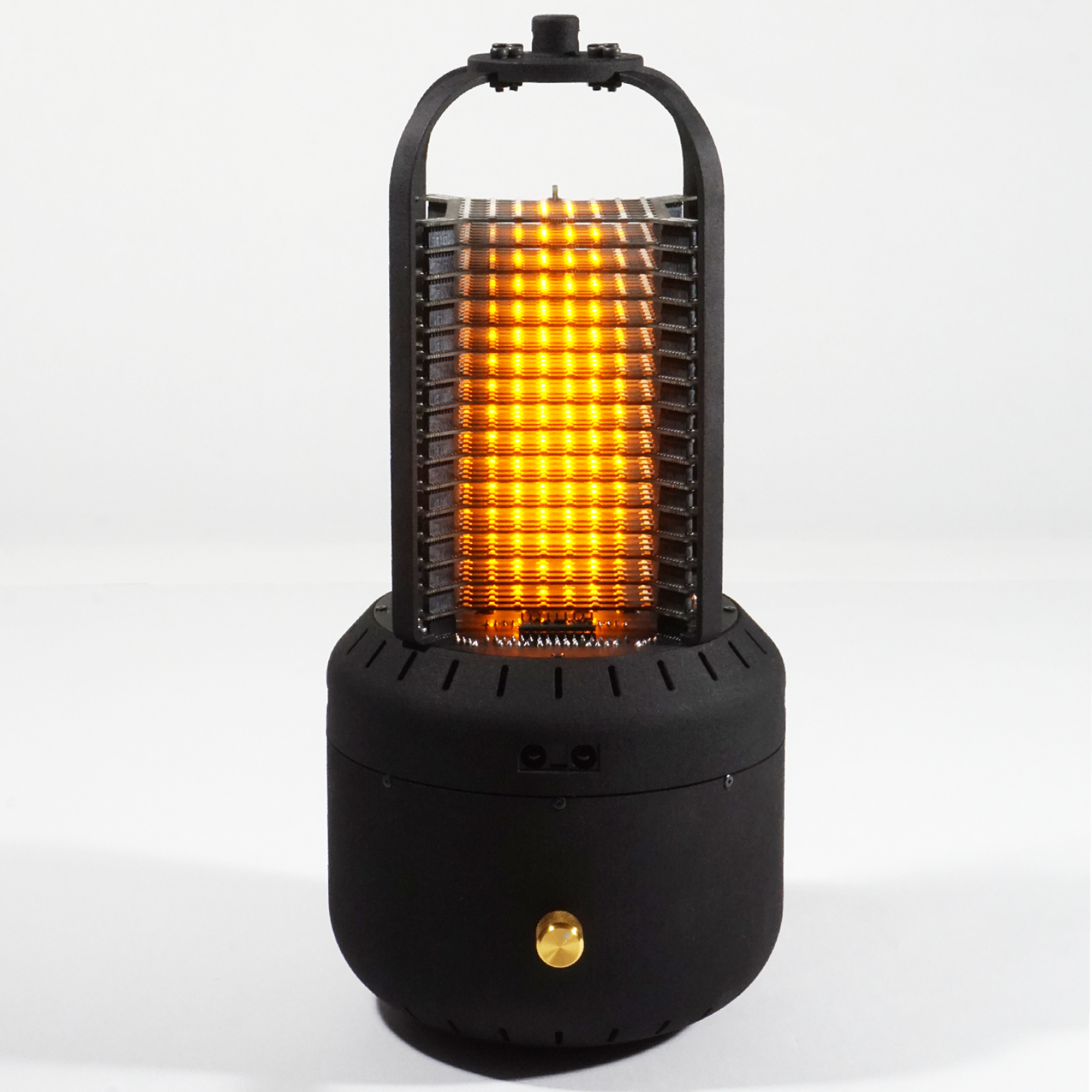

Text ConfessionIt is a desire inherent in many of us to preemptively plan an alternative world and realize potential things that dont exist at this moment by using various methodsThe LED Cube project was one of such kind for me At the time when I first sa
Confession
It is a desire inherent in many of us to preemptively plan an alternative world and realize potential things that don’t exist at this moment by using various methods.
The LED Cube project was one of such kind for me. At the time when I first saw these examples on the web, LED cubes generally remained hobby projects and didn't have usability or meaning. They displayed plain geometrical shapes or letters created by a microcontroller.
For some mysterious reasons that couldn't be explained, I was eager to light a fire into it. Not a real flame of course, but I imagined a visually convincing fire effect would be a suitable application that fits the aesthetic of an LED cube.
Normally, investigating the problems of a particular product or service is the first step, and making a solution is the next. That is how I was taught in design school for years. However, at that moment, the process of the project-making worked the other way around which is the way I was told I should avoid in the design process.
This entire project was driven by internal impulses, not by reason. I envisioned what I shall make in the future first and the process of persuading myself followed. As if I was under a spell or hypnotized after gazing at a flame for hours, through years of realizing this project, internal energy pushed it further.
Double Width
On
Component
Text RationalizingOne of the goals of this project was to seek proper solutions to fabricate a trivial imaginary fiction into an actual being To do it the project pursued technology that creates the overlapping state of reality and virtuality by taking th
Rationalizing
One of the goals of this project was to seek proper solutions to fabricate a trivial imaginary fiction into an actual being. To do it, the project pursued technology that creates the overlapping state of reality and virtuality by taking the form of familiar objects we use every day.
Finding the usefulness of the contraption would be good for the first step of the development process. It provides multiple ways to future outcomes of the project and ideas about how to approach the process of making. In this project, setting a concrete and practical purpose for the outcome was the main approach to realization.
The anticipated picture of the project was making the LED cube as a lighting device and also, instead of simply using an LED cube as a light device, this project was an attempt to realize a completely different dimension of illumination through the changes in the light source.
Double Width
Off
Component
Text Questions and solutionsWhat are the possible ways of integrating programmable illumination of LED cube and functional usefulness of lighting deviceLED cubes are lighting that can be programmed and display images However the intensity of the light its
Questions and solutions
“What are the possible ways of integrating programmable illumination of LED cube and functional usefulness of lighting device?”
LED cubes are lighting that can be programmed and display images. However, the intensity of the light itself compared to the conventional light is relatively lower. It would be nice if there were supplementing solutions to enhance the lack of light intensity by using the programmability of LED cubes. As a result, displaying animations depicting fire inside the cube would be the solution for the lighting.
“How could the LED CUBE reproduce primitive and inspiring illumination like flames through practical commodities such as lighting?”
Flame is closely related to the light. For many instinctive reasons, many people automatically associate the image of the flame with the senses of light and heat. By reproducing the image of flames, it is possible to strongly convey the impression that it surely emits light from an LED cube that lacks the overall amount of light.
Double Width
Off
Component
Practices (on papers)


Text Drawings for ideationIt was necessary to extract essential components to work for realizing possible outcomes before the project was conducted When working on this Finding examples of similar work was hard Therefore it was necessary to clarify the ty
Drawings for ideation
It was necessary to extract essential components to work for realizing possible outcomes before the project was conducted. When working on this, Finding examples of similar work was hard. Therefore, it was necessary to clarify the type of work. This work aimed to secure usability so that it can be used in everyday life rather than as a temporary installation.
As a result, lighting used in the past, especially lighting devices that used ‘fire’ as a light source, was used as reference materials. Among them, the design and appearance of portable lighting devices were reflected in the design.
Double Width
Off
Component

Text System configurationThe results that need to be achieved were narrowed down into three categories such as product feelings overcoming technical difficulties and various usable concepts To secure these there are three main points that the project was
System configuration
The results that need to be achieved were narrowed down into three categories such as product feelings, overcoming technical difficulties, and various usable concepts. To secure these, there are three main points that the project was focused on.
The first key element is that it aims essentially a product rather than a temporary installation. Therefore, it must be able to operate independently without any connection to a large device.
Second, the generated images should be new ones created each time, not repeating the stored image.
The last is that those images must have elements of interaction that are affected by the user or environment and the user is affected by it.
Double Width
Off
Component
Iterations (software)
Text SOFTWARE DEV PROCESSCaptions for the picture1 Flame simulation screen in 2D space Flame was depicted by particles2 It is expanded into a 3D space The particles show the flame and the velocity field can be observed as a vector line in the simulation3
SOFTWARE DEV PROCESS
Captions for the picture
1. Flame simulation screen in 2D space. Flame was depicted by particles.
2. It is expanded into a 3D space. The particles show the flame, and the velocity field can be observed as a vector line in the simulation.
3. The flame was fitted into the LED resolution. On the left and center, the flame is represented by particle counting, and on the right, it is depicted by the temperature field.
4. Completed flame representation. This is the expression when the gas generated by the flame reaction reaches above a certain temperature.
Double Width
Off
Component

Text A goal for the fire simulatorTo give more illusion to people it is necessary to be able to reproduce the movement of the real fire and its irregularity so that the same image can be triggered when looking at the flame in cubes It is also important to
A goal for the fire simulator
To give more illusion to people, it is necessary to be able to reproduce the movement of the real fire and its irregularity so that the same image can be triggered when looking at the flame in cubes. It is also important to ensure the movements and changes occur by interacting with the external environment.
The change in flame generated by this interaction acts as an optical illusion to make it feel real. Because of this requirement, the flame itself had to be created.
Double Width
Off
Component
Text
Double Width
Off
Component
Text Objectives and solutionsInitially a fluid simulation was implemented in a twodimensional space to make particles move along the fluid movement The fluid motion was generated by the spark ignition algorithm The fluid space was expanded in 3D to create
Objectives and solutions
Initially, a fluid simulation was implemented in a two-dimensional space to make particles move along the fluid movement. The fluid motion was generated by the spark ignition algorithm. The fluid space was expanded in 3D to create a fluid space and implement the movement of the particle inside the space.
To display the fire on the screen on the LED cube, it is necessary to convert the shape of the visible fireworks into a form that can be transmitted to the LED. Since the LED Cube has a resolution of 8x8x16 and the individual LEDs are fixed, the coordinates of each LED and grid of the space where the fire is displayed must match. In addition, the brightness of the flame on the fluid field must be calculated and transmitted to the corresponding LED.
Double Width
Off
Component
Text The 3D calculation was performed in 2D In OpenGL 21 or OpenGL ES there was no function for calculating a threedimensional texture Therefore it needed to convert the 3D texture to 2D To perform 3D calculations of 18x18x18 size 18 textures of 18x18 siz
The 3D calculation was performed in 2D. In OpenGL 2.1 or OpenGL ES, there was no function for calculating a three-dimensional texture. Therefore, it needed to convert the 3D texture to 2D. To perform 3D calculations of 18x18x18 size, 18 textures of 18x18 size were required. Therefore, a single texture performed all grid operations at once.
The outcome was moved to the pixel accessible by the CPU and stored in an array. Map the values stored in the array to brightness values between 1 and 255, and send them to the LEDs in order.
Double Width
Off
Component

Iterations (hardware)


Text Prototyping processMany iterations were conducted to get a good shape of the device and to fulfill functions that were required to achieve proper feelings of fire as the lighting A total of 5 LED cubes were made during the prototype processFrom the f
Prototyping process
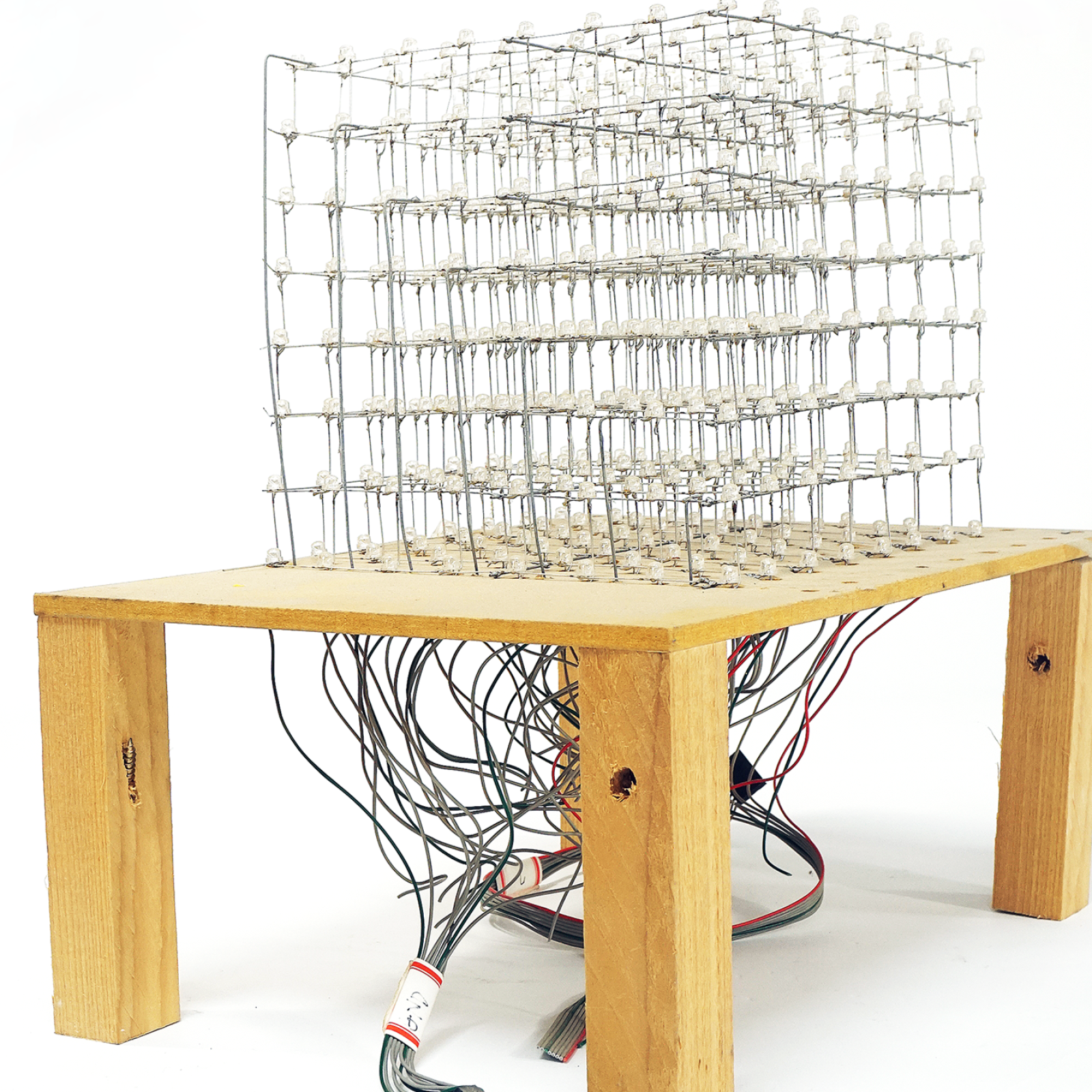
Many iterations were conducted to get a good shape of the device and to fulfill functions that were required to achieve proper feelings of fire as the lighting. A total of 5 LED cubes were made during the prototype process.
From the first to the fifth, a series of skills such as how to understand Openframeworks programming, micro-controller programming, basic circuit design, PCB pattern design, and reading datasheets for components were needed. In addition, It was necessary to recognize what trials and errors had to be done to make the outcome work properly.
Getting a rigid construction of the cube by using conventional materials such as brass and wood was not a good approach. Because of the limitation of budget and access to high-end tools, there were always tolerance and durability issues that caused problems during the assembly process. After a couple of times of iterations, the entire structure of the LED cube itself was replaced by PCB making. It was a radical change for a not trained maker, but the solution solved most of the issues.
Double Width
On
Component
Text
Double Width
Off
Component


Text
Double Width
Off
Component
Text
Double Width
Off
Component
Text Finalizing the workThe last integration phase began with the process of readjusting each designed part to fit in production tolerances In particular the process of ensuring the proper assembly between 3D printed housing and circuit board was essentia
Finalizing the work
The last integration phase began with the process of readjusting each designed part to fit in production tolerances. In particular, the process of ensuring the proper assembly between 3D printed housing and circuit board was essential. Although this was a repetitive process, it was an important step to avoid low-quality crude mock-ups and secure the quality and durability of the outcome.
In addition, putting a single board computer and battery inside the device and integrating them so that they would not be shaken by external shocks was challenging. Otherwise, internal components would be moving and damaging the delicate parts while it's running.
In reality, a process of trial and error is necessary before spending a large budget for production. This stage ultimately reduces the time and money it takes to produce. Balancing the time and resources between testing and producing is always worth considering.
Double Width
On
Component
Fire vessel series
Text Fire vessel 1Materials Glass dome 3D Printed housing LEDs Udoo x86 Arduino 101 Custom PCBSoftware Openframeworks OpenGL Arduino CProduced with support from the Korea Foundation for the Advancement of Science Creativity Seoul
Fire vessel 1
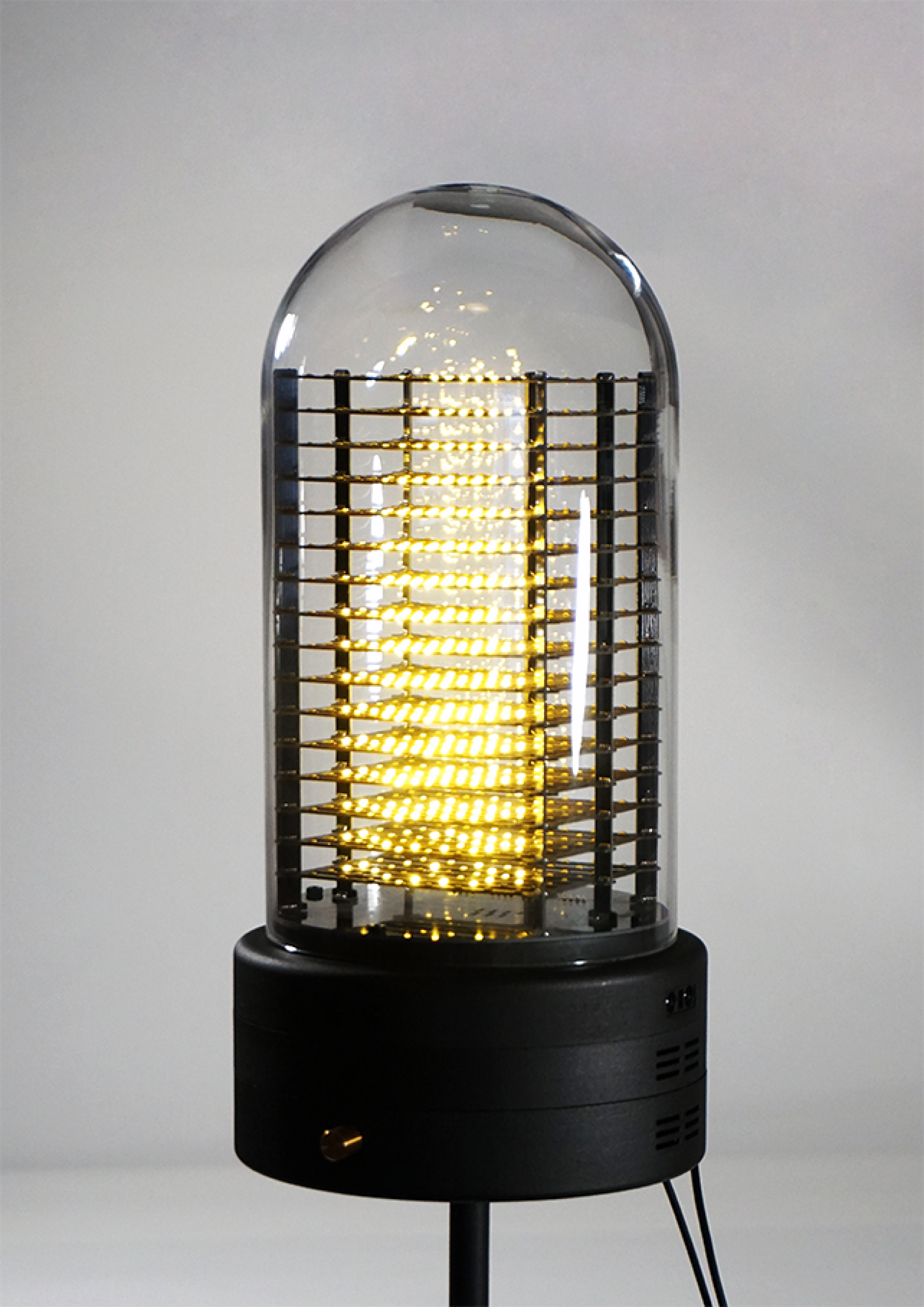
Materials: Glass dome, 3D Printed housing, LEDs, Udoo x86, Arduino 101, Custom PCB
Software: Openframeworks, OpenGL, Arduino, C
Produced with support from the Korea Foundation for the Advancement of Science & Creativity, 한국과학창의재단, Seoul
Double Width
On
Component
Text Fire vessel 2Materials 3D Printed housing LEDs STM32F103 Latte panda SBC Custom PCBSoftware Openframeworks OpenGL HAL CProduced with support from the Korea Foundation for the Advancement of Science Creativity Seoul
Fire vessel 2
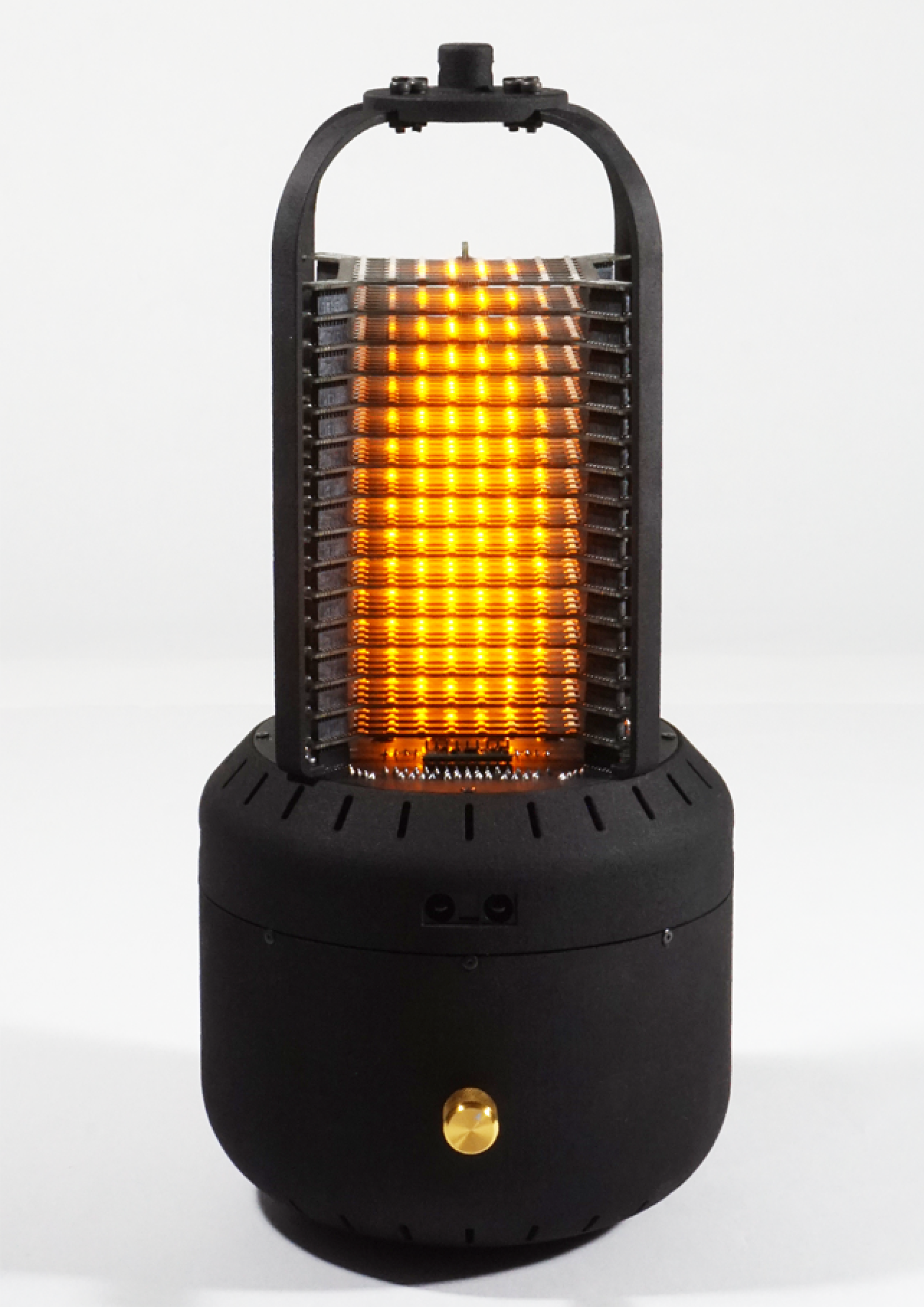
Materials: 3D Printed housing, LEDs, STM32F103, Latte panda SBC, Custom PCB
Software: Openframeworks, OpenGL, HAL, C
Produced with support from the Korea Foundation for the Advancement of Science & Creativity, 한국과학창의재단, Seoul
Double Width
On
Component


Text ReferencesJos Stam RealTime Fluid Dynamics for Games Proceedings of the Game Developer Conference March 2003Knut Erik Samuel Rdal Geir Storli Physically Based Simulation and Visualization of Fire in RealTime using the GPU NTNU June 2006
References
Jos Stam. "Real-Time Fluid Dynamics for Games". Proceedings of the Game Developer Conference, March 2003.
Knut Erik Samuel, Rødal Geir Storli. Physically Based Simulation and Visualization of Fire in Real-Time using the GPU. NTNU, June 2006
Double Width
On
Component