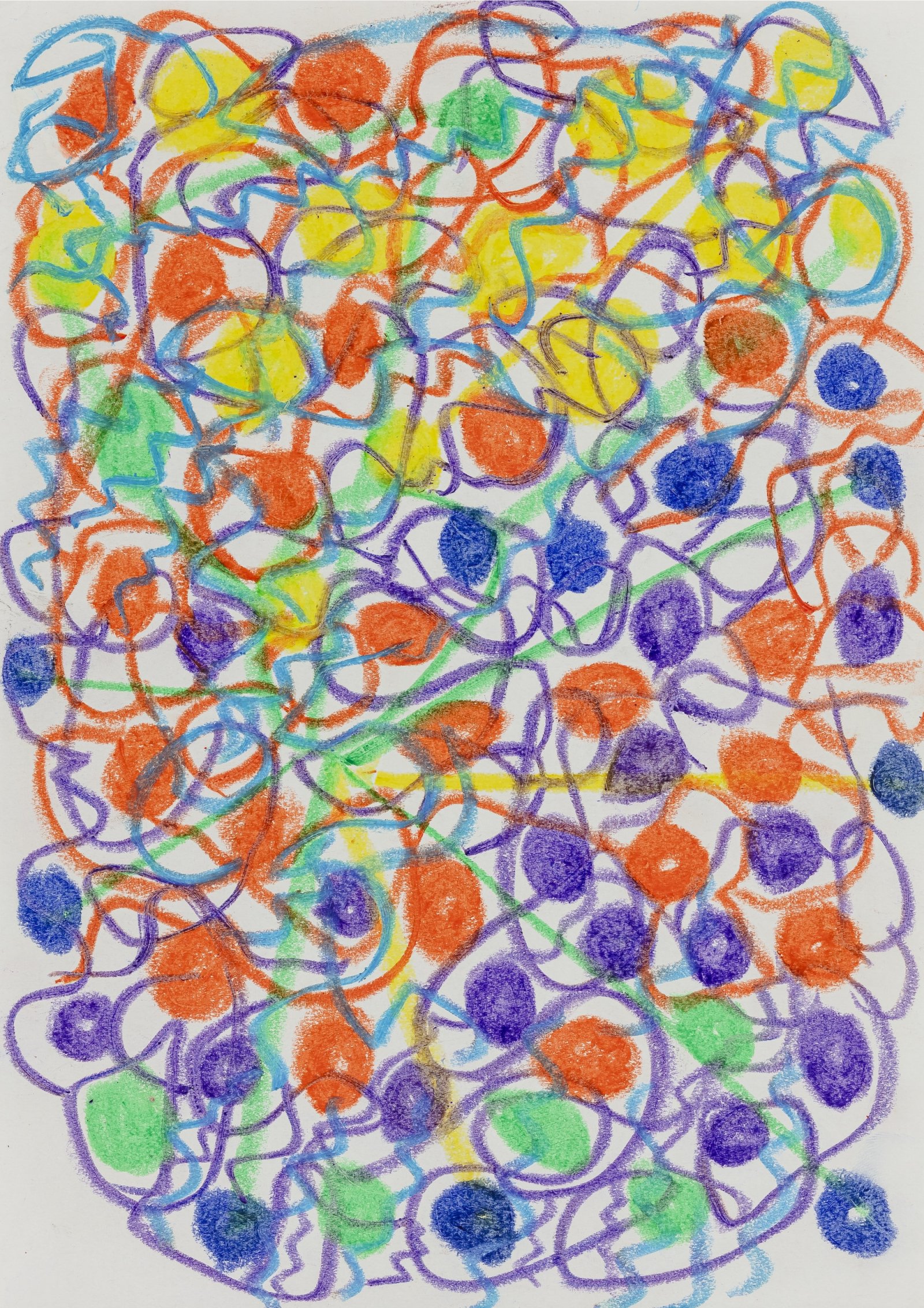
Text In 1978 Andr Taniki Yanomami experimented with oil pastels for the first time 1 Before then his drawings had been executed with felttip pens in various colors His exploration of new techniques changed the very structure of his work pens allowed for f
In 1978, André Taniki Yanomami experimented with oil pastels for the first time. [1] Before then, his drawings had been executed with felt-tip pens in various colors. His exploration of new techniques changed the very structure of his work: pens allowed for fine, uniform lines and meticulous detail, while pastels, with their broader contact with the paper, enabled larger areas to be covered, encouraging the images to expand to a different scale. In this series of drawings—closer to free abstraction than the figurative-narrative approach of his earlier works—lines appear denser and thicker, and the most striking feature is the filling of planes. These works emerged from his exchanges with Bruce Albert. [2]Many of these drawings display a profusion of circular forms, sometimes arranged in grids and at other times in radial patterns, reminiscent of a morula. In others, broad bands—often along the edges of the paper—create striped chromatic compositions. Frequently, a circle’s outline is drawn in one color and filled with another, while the connecting lines remain vibrant and tangled. This sinuosity reflects, in part, the dynamism of the descent and dance of the xapiri pë spirits, the cosmological and sensorial agitation of shamanic experience, and the electric charge of certain neurophysiological mechanisms—such as the perception of luminous patterns caused not by external light but generated by the nervous system through neuroelectric stimuli. These patterns are known as phosphenes, which can be perceived with the eyes either closed or open, “and, in that case, may appear superimposed upon normal vision.” [3]In a 1978 study, Austrian anthropologist and archaeologist Gerardo Reichel-Dolmatoff (1912–1994) analyzed drawings of phosphene-derived forms made by Tukano peoples, noting that this photic phenomenon “can be chemically induced by the ingestion or injection of narcotics,” [4] including ritual psychotropics and hallucinogens. Luminous phenomena can also take on more defined forms when emotionally stimulated, as in shamanic rituals carried out through songs, music, and dance, as well as through the consumption of yãkoana [5] and prolonged fasting. On the visible shapes of phosphenes, Reichel-Dolmatoff observed that “some of these photic sensations are hardly more than sudden flashes, stripes of light, or scintillating shapeless flickers that pass over the field of vision like lightning, but others may appear as well-defined, abstract, geometrical patterns, sometimes of a remarkable complexity.” [6] Visions, then, may result from phosphenes—chemical and physiological in origin [7]—but, in shamanic or hallucinogenic trance, they can merge with figurative representations that belong clearly “to a stage dominated by cultural projections.” [8]In a context drastically different from Taniki’s, the Japanese artist Atsuko Tanaka (1932–2005) [9] devoted her practice, from 1956 to 2005, to paintings and drawings characterized by repeated circular motifs, curved lines, and chromatic intensity—elements that, for Tanaka, heightened the incendiary character of her works, as if demonstrating electrical systems in operation. These conductors, however, did not seek order: they disoriented more than they oriented, representing entropic and dynamic systems where one might otherwise expect the rationalist order of industrialized Japan or the formal rigidity of mechanical and electrical engineering. In her works, repeated circular forms are connected by capillary-like networks that affirm their vibration and energy, resembling “overactive magnetic circuits or chaotic solar systems, each planet struggling to establish a regular orbit.” [10] Her practice reflected a fascination with electrical circuits, lightbulbs, and buzzers connected by intricate wiring.In an untitled painting from 1959, Tanaka covers the canvas with circles of similar diameter and varied colors, linked by equally colorful sinuous lines that form a chaotic network of conductors, as if composing a rhizomatic system. The Japanese artist’s work and a significant group of pastel drawings by Taniki from 1978 converge, not only in graphic aspects [11]—the presence of varied and interconnected patterns, luminous points or discs flashing in multiple colors, at high intensity and speed—but also in terms of energetic circuits and imagistic dynamics. Whereas Tanaka’s work relates to the entropic electrical circuits of post-industrial Japan, Taniki’s engages with the energetic transits of shamanic practices, the role of psychotropics in such experiences, and the Yanomami cosmological principles of the image.The vibration of these conductive systems recalls the intensity with which the Yanomami describe the mirror (mireko or mirexi): vast planes adorned with resplendent white feathers, utterly free of impurity, across which the spirits ceaselessly run, play, and dance. These mirrors are usual protagonist of Yanomami artists’s works, as in a work by Joseca Yanomami in which the mythological entity Thuëyoma, daughter of Tëpërësikɨ and wife of Omama, dances over a mirror. The dwelling place of the spirits, situated on the sky’s back, is filled with these shimmering mirrors, and when they descend in shamanic visions, they refuse to touch the sullied ground of the lower celestial stratum, thereby preserving the luminous integrity of their own space.